An SEO consultant is the person who works out why your business is not being found on Google, fixes what is holding it back, and then builds the pages that earn you the right customers.
I do the diagnosis, the plan and the follow-through myself, and I show you the work in Search Console, not in a glossy monthly report.
What a consultant actually does, at a glance
- Audits: what Google can and cannot see on your site
- Keyword mapping: one main keyword per page, a supporting set for each money page
- Technical fixes: rendering, speed, mobile, indexing, schema and internal linking
- Content: pages and blogs that support the service pages, not traffic for its own sake
- Links: checking your link profile and earning links. Never buying them.
- Local and Google Business Profile: the profile, reviews and local pages that bring nearby enquiries
- AI search visibility: clear, consistent answers so AI Overviews and chat search can cite you
- Reporting: enquiries, calls and bookings, in Search Console terms you can check
The rest of this post expands on that list, with two real examples. Most small business owners I speak to have already paid for SEO once and still do not know what was actually done.
What I do in the first four weeks
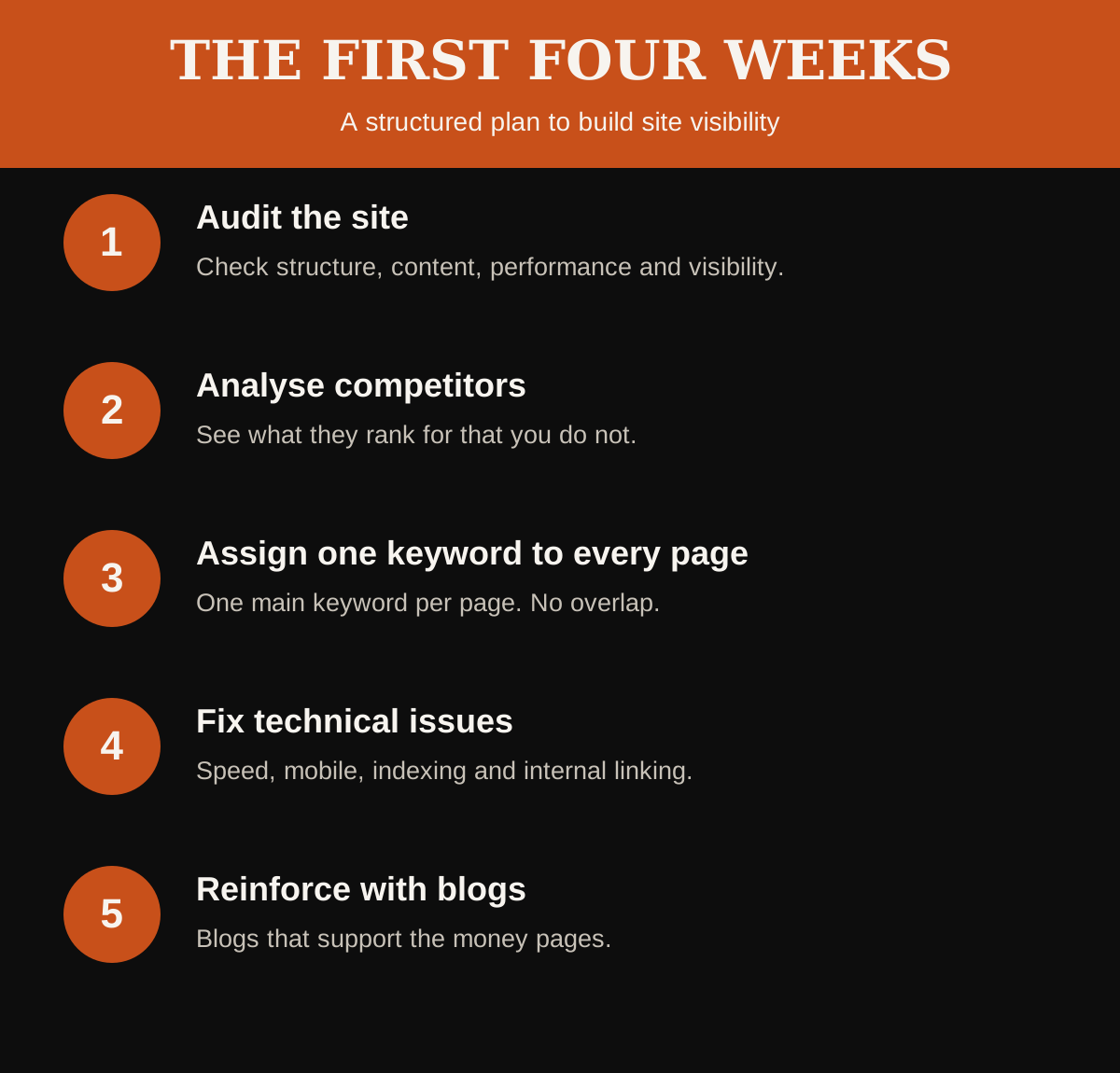
1. Audit first
I start with an audit. I look at the site as Google sees it, not as it looks in a browser.
- Whether pages render properly
- Whether the schema is in place and correct
- How the blog and the rest of the site link together
- Whether Google is showing the sitelinks and pages you actually want it to show
If something is broken at that level, no amount of new content will fix it. I learned that order on my own site, where 47 pages sat in Search Console as discovered but never crawled, because the foundations had not been sorted before the content went up.
2. Study the competitors
At the same time I look at your competitors. Not to copy them, but to see what they rank for that you do not, and where the gaps are that a smaller site can realistically close.
3. Assign one keyword to every page
Then I assign a specific keyword to every page, and a specific set of keywords to every money page. A money page is a page meant to bring in enquiries, like a service page.
It gets one job, one main keyword, and a supporting set around it. When every page tries to rank for everything, none of them rank for anything.
4. Fix, then reinforce with blogs
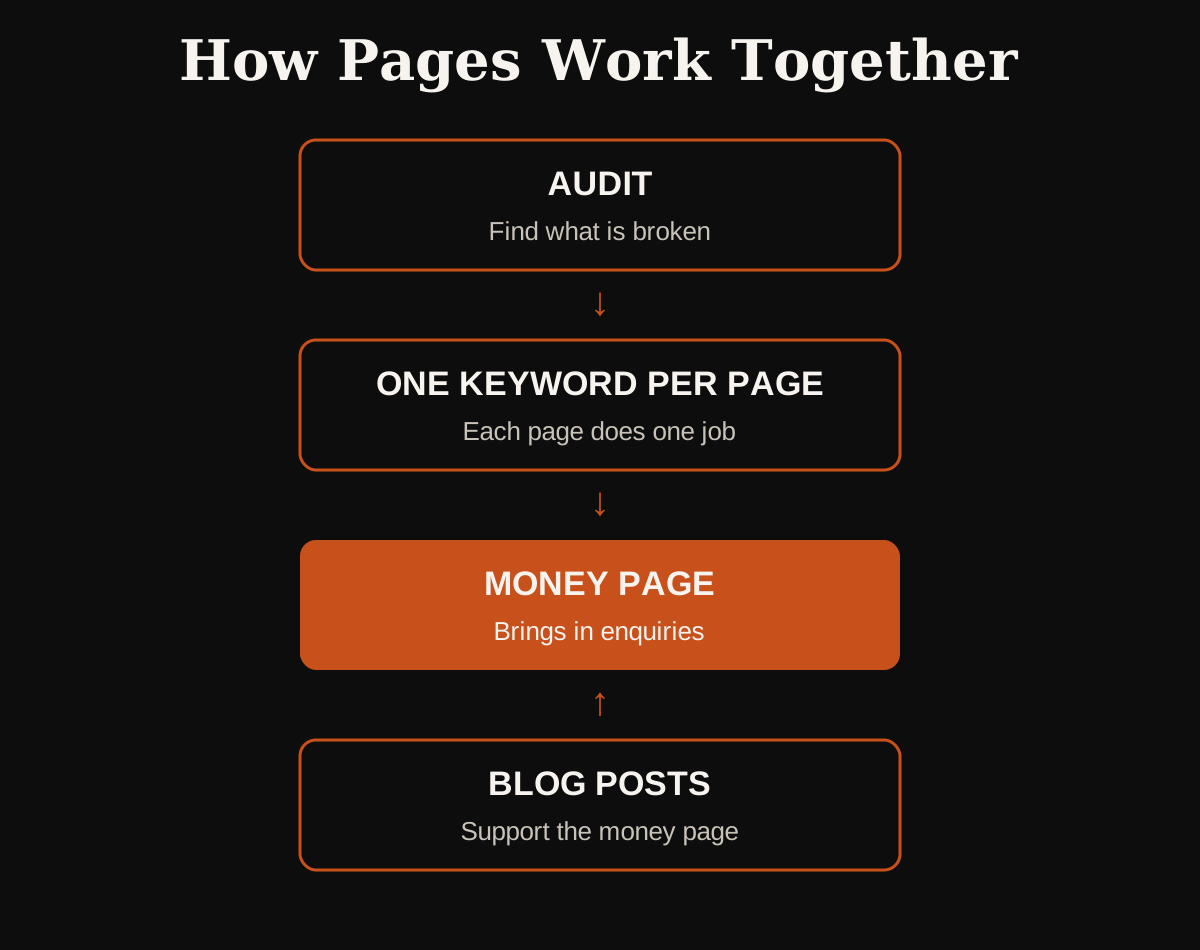
- Blogs support the money page they link to
- They answer the question a customer asked before they were ready to buy
- They give Google more evidence about what your site is about
The audit decides the keywords, the money pages carry them, and the blogs back them up.
The client does their part too, and it is smaller than most people expect. You answer questions about your customers, approve the direction, and tell me when something I have written does not sound like your business. You do not need to become an SEO expert to hire one.
What I look at in Search Console
Once the audit is done, I spend a lot of time in Google Search Console, under Queries. That is where Google tells you, in its own words, what people typed before they saw your site.
What striking distance means
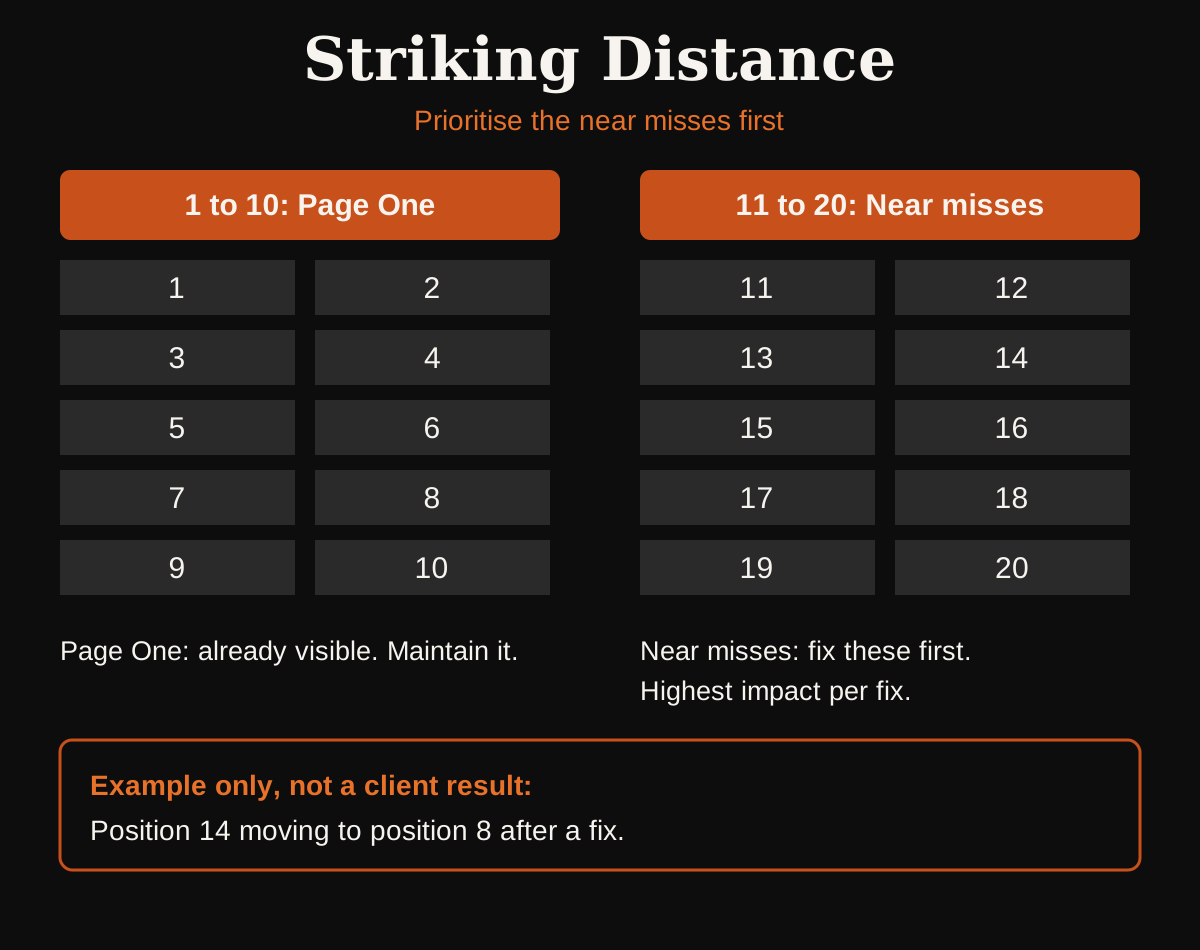
- Some pages already rank on page two or three for a useful search
- They are close enough to page one that a focused fix can move them
- A page at position 14 for a term a customer would type is nearly working
- A page at position 90 is a different conversation
So I prioritise the near misses first, fix what is holding them back, and measure whether they move. That is also how I decide what to write next.
Two recent examples, without the client names
A taxi service on Next.js
A taxi service came to me with a site built on Next.js. On the surface it looked fine, but pages were not rendering the way Google needed them to. A visitor saw the content, but the search engine was not getting the same picture.
I found the rendering issue, fixed it, and the site could then be read properly. Writing more blog posts would not have solved it. The audit found it because the audit looked at rendering first, before anyone wrote a word.
A B2B site on WordPress
The other recent example was a B2B site on WordPress. The site itself was sound, but the meta titles and descriptions did not say clearly what each page was about.
I optimised them so each page stated its subject plainly, in the same language a customer would search with. Just every page introducing itself properly, so Google and the person reading the result both knew what they would find.
No trophy numbers here
I am not claiming a ranking result for either client. The point is the diagnosis, not a trophy number.
Similar work is in my case studies, with the client details that can be shared.
After the first four weeks
The monthly rhythm
- Which queries are moving, and which pages are still stuck
- Which near misses have moved into striking distance since the last fix
- Whether a page that has not moved has the wrong keyword, thin content, or a technical fault still in the way
If a page moved from position 14 to position 8 after a technical fix, that tells me the diagnosis was right. If a page has not moved at all, I do not keep doing the same thing and hope. Monthly SEO that never revisits its own decisions is just a subscription with a report attached.
What new content is for
New blogs are not written because a calendar says it is Tuesday. They are written because a money page needs support, because Search Console shows a question customers are asking that no page answers properly, or because a page that should rank is missing the evidence Google needs to trust it.
What I will not do
- I will not buy links to force a ranking
- I will not publish thin pages to chase a keyword
- I will not promise a position by a date
A consultant who will not say no to a bad idea is not being helpful, they are being agreeable, and agreeable is expensive.
Links, local search and AI search
Off-page work, honestly described
Beyond refusing bought links, I check the link profile and pursue links a real site has a real reason to give: a useful page, a genuine mention, a directory or partner listing that fits the business. That is slower than buying links, and it is the part that does not come back as a penalty later. See link building services for how that work is scoped.
Local SEO and Google Business Profile
For a taxi firm, a clinic or a trades business, the first search is often local. That means the Google Business Profile has to be complete and accurate, reviews have to be handled, and the site needs local pages that match the services and areas you actually cover. That work sits under local SEO, and it is where most small-business enquiries start.
AI search and AI Overviews
Buyers now also ask whether they will appear in AI search and AI Overviews. The work there is not a separate trick. It is the same foundations done consistently: clear entities, consistent names and services everywhere, pages that answer one question properly, and content other sources can cite.
How much does it cost?
The audit costs $149, one-off. Monthly work starts at $199, with Growth at $399 and Authority at $699, depending on site size, local competition and how much work is actually needed. The full detail lives on the hire-me page.
Prices vary widely across the market for the same reason: a small local site and a large ecommerce site are not the same job, and a fixed price given without looking at the site is a guess, not a quote.
Start with the audit if you have never had proper SEO work done. It answers what is wrong and what to fix first, and it gives you something concrete to judge me by before any monthly commitment.
What kind of consultant do you need?
- Local: you serve a town or region and need nearby enquiries — see local SEO
- Technical: the site is not being read, indexed or rendered properly — see technical SEO
- Ecommerce: products, categories and filters are competing with each other — see ecommerce SEO
Most small businesses need a mix, in that order: technical soundness first, local visibility next, then content and links. The full list of services shows how those pieces fit together.
Questions to ask before hiring
- What do you think is wrong, and what evidence is that based on — a specific page, not a vague claim about authority?
- What will you do first, and what will you deliberately not do yet?
- How will results be reported, in terms I can check — enquiries, calls and bookings, not just a traffic line?
- What happens if it does not work, and how can the contract be ended?
- Who owns the accounts and access if we stop working together?
A serious answer connects a finding to a page on your site and to a customer you want. A vague answer tells you they have not looked closely enough.
What a consultant is not
Not a tool subscription, and not a monthly PDF. If you are paying for SEO and the only thing you receive is a report telling you your traffic went up or down, you have bought a report, not a service. A report does not fix a rendering issue, rewrite a meta description, or decide which keyword a page should carry.
Not an agency retainer in miniature either. I work directly with the owner, I do the work myself, and when something is wrong I say so in plain terms.
When you do not need a consultant
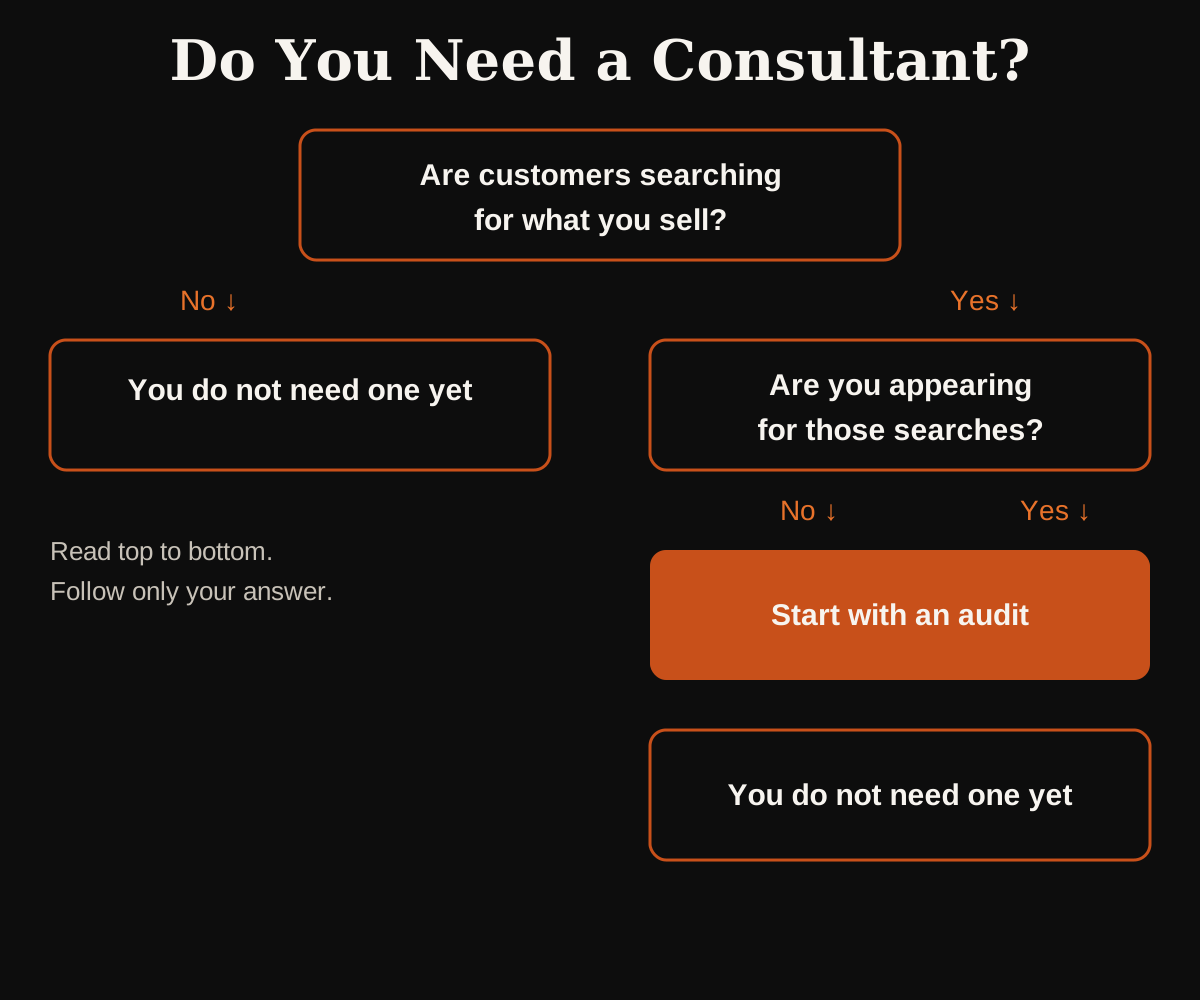
You do not need one if your site is already bringing in the enquiries you can handle, and you are happy with where you appear for the searches that matter. You also do not need one if the problem is not search at all, if your customers come from word of mouth or repeat work and you are turning work away.
Hiring a consultant to fix a problem you do not have is a waste of your money, and I would rather tell you that on a free call than sell you a retainer and work it out later.
You do need one when you know customers are searching for what you sell, you are not appearing for those searches, and you do not have the time or the technical background to diagnose why. That is the gap I fill. You run the business, I make sure Google can find it and understand it.
What this post leads into
Next in this series: cost, audit, hiring and technical audit, each in its own post. I will link them here as they go live. For the deeper idea behind all of it, see The Complete Guide to Topical Authority in 2026.
What to do next
If that sounds like your situation, the honest starting point is an audit. It costs $149, it is a one-off, and it tells you what is actually wrong before anyone talks about monthly work.
Audit first, assign every page its keyword, fix the technical faults, then build the content that supports the pages meant to bring in work.
You can also book a free call first and talk it through, and if I think you do not need me, I will say so.